


 Book an Appointment

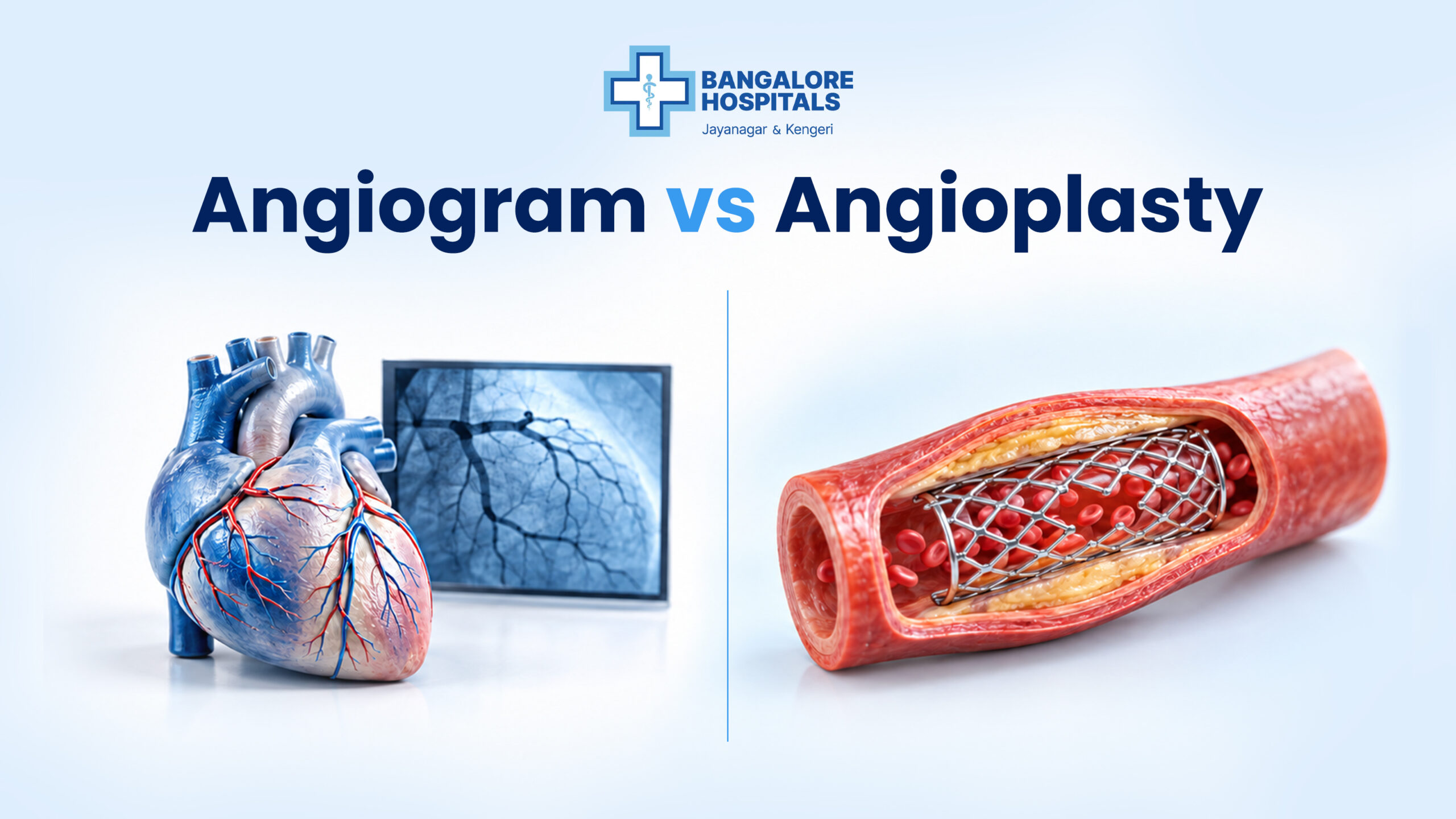
In cardiac-related problems, we often come across two common terms: Angiogram and Angioplasty. Angiograms and angioplasty help diagnose and treat heart blockages. Cardiologists perform these procedures in outpatient settings because they are minimally invasive. Sometimes we complain of chest tightness or sudden pain, and cardiologists perform the test in a catheterization lab. However, as laypeople, we might think these two are the same because the names sound similar, but they are different procedures.
An angiogram is a diagnostic process that showcases how blood flows through your heart and blood vessels. Angioplasty, by contrast, is a procedure that maintains blood flow in an artery by removing the plaque that obstructs it. Bangalore Hospitals has the best cardiologist and cardiac department to support any emergency or cardiac-related treatments.
What Is an Angiogram?
It is a common test, often described as a heart X-ray, used to see whether the heart’s blood vessels are working properly. An angiogram identifies blockages or narrowing of blood vessels. Doctors use a coronary angiogram to recognize coronary artery disease. A coronary angiogram is part of a group of heart tests known as cardiac catheterization. In this process, one or more thin, flexible catheters are placed within the major blood vessels of the heart and different parts of the body. During this procedure, a small skin incision is required to insert the catheters. Patients with blockages can undergo angioplasty and stenting to open the blocked arteries.
In this angiogram procedure, a computerized tomography (CT) machine maps the heart vessels and does not require inserting tubes into the body. This technique is called a Coronary CT Angiogram (CCTA). However, if the test shows a heavy blockage or a narrowed artery, then a catheter-based angiogram is required.
The main goal of coronary angiography is to identify narrowing or blockages. If treatment is required, angioplasty may be performed during the same catheter-based procedure. In general, two main access points for angioplasty: one is radial (through the wrist), and the second is femoral (through the groin). The choice depends on the patient’s condition and the situation.
Angiography Process
The patient may feel numbness where the catheter is inserted as the needle accesses the blood vessels. Then, the catheter is placed over the needle into a large artery. The catheter is then cautiously and slowly threaded through the artery until the tip reaches the area of the blood vessel that needs to be examined. A small amount of contrast material (dye) is injected into your blood vessel via the catheter; then X-rays are taken to see where and how well blood is flowing through your blood vessels. Watch where the contrast agent goes on the X-ray monitor. This process could take ten to fifteen minutes. However, if no additional care is needed, you will typically be released in a few hours.
Complications of Angiogram
Common complications include bruising and soreness at the catheter insertion sites. Some rare complications patients may face include dizziness, allergies due to the use of dye, breathing difficulties, internal hemorrhage, kidney failure, and stroke.
What Is an Angioplasty?
It is a minimally invasive procedure that widens narrowed or blocked arteries and improves blood flow.. This is a common treatment for heart diseases like atherosclerosis, where plaque made of fat and cholesterol blocks blood vessels. Through this process, a tiny medical balloon pushes the plaque to create space for blood to flow. It is safe for mild to moderate blockages and is less invasive than bypass. Angioplasty prevents serious complications and deterioration of the heart due to atherosclerosis, improves blood flow, and relieves symptoms.
Types of Angioplasty
Based on which arteries are treated, it can be classified into two categories:
- Coronary artery angioplasty: Coronary arteries are the blood vessels that bring blood to your heart. Percutaneous coronary intervention (PCI) is another name for this process. When angioplasty is performed to treat a coronary heart blockage, it is known as Coronary artery angioplasty.
- Peripheral artery angioplasty: Peripheral arteries carry blood away from the heart to areas such as the legs and arms. Peripheral angioplasty is used to treat narrowed or blocked peripheral arteries.
Angioplasty comes in different types, each made to treat a different heart problem. Most people have one of these types:
- Balloon Angioplasty: This is the most common type of angioplasty. A catheter with a small inflatable balloon is inserted into the clogged arteries to widen them and push the plaque against the artery walls.
- Stent Placement: A stent is placed in the arteries to keep them from narrowing again. Compared with a stent, traditional angioplasty uses a balloon, while a stent places a small metal tube.
- Laser Angioplasty: This high-tech process uses a laser to melt or remove plaque that has built up in the arteries. This method is used when balloon angioplasty or stenting isn’t possible.
- Megavac Angioplasty: This high-tech treatment removes blood clots in the arteries. It works especially well when there are severe blockages, like when someone has serious coronary artery disease.
Angioplasty Procedure
Before treatment, the doctor explains all details about the angioplasty procedure. The coronary angioplasty procedure is done with local anesthesia and lasts between 30 minutes and two hours. An IV will be placed so that sedatives and fluids can be given. Monitoring devices will also be hooked up to monitor your vital signs and oxygen levels. During the procedure, the doctor will numb the area where the catheter will be placed with local anesthesia. Most often, the wrist or groin is used as the entry point. A fluoroscopy machine will guide the tube into the body.
Once the provider reaches the target artery, they will inflate the balloon on the catheter to widen it. After balloon angioplasty, a stent may be placed to keep the artery open and reduce the likelihood of it narrowing again. After the procedure, the patient will be monitored for a while, depending on how well recovery and healing progress.
Recovery Process
Most people recover quickly from angioplasty because it is a minimally invasive treatment. But people need to get the right aftercare to stay healthy in the long run. Patients should avoid heavy lifting and driving for a while after getting home. Keep the insertion site clean and dry, and watch for early signs of infection. Eat a heart-healthy, nutrient-rich diet, and limit salt and saturated fat. As your doctor tells you, you can slowly start doing light activities and exercises again. If you want to keep your heart healthy after getting a stent, avoid smoking and follow your doctor’s advice regarding alcohol consumption.
Complications after Angioplasty
No matter how safe angioplasty is, it still carries risks, just like any other treatment. Heavy bleeding or bruises at the site where the catheter was inserted are common risks. Once the tube is in place, or even inside the treated artery, blood clots can form. An infection at the insertion site is a possible problem that needs close monitoring. Restenosis, or re-narrowing of the treated artery, can occur after angioplasty. Angioplasty can sometimes cause a heart attack or stroke in rare cases.
Angiogram vs Angioplasty: Side-by-Side Comparison Table
| Key Features | Angiogram | Angioplasty |
| Purpose | This process is performed to find visual blockages in the blood vessels | This procedure is performed to open the blockage and normalize the blood flow |
| Invasiveness | It is a minimally invasive process | Similarly, angioplasty is also a minimally invasive process |
| Duration | It takes around 30-60 minutes to complete the process. | It takes longer than angiography, around 60-90 minutes or more. |
| Anesthesia | Used local anesthesia | Local anesthesia with mild sedation is applied |
| Hospital Stay | Same-day release | It can take 1-2 days of hospital stay based on the patient’s condition |
| Recovery Time | The patient can recover within a few hours after the process | After angioplasty, the recovery depends on the patient’s condition and health. Sometimes it takes a few days to weeks for complete recovery |
| Risk Level | The process has generally low risk | It can be considered low to moderate risk depending on the patient’s condition |
| Cost Range | Angiogram is a diagnostic procedure, so the cost is relatively low | It is a minimally invasive procedure that is comparatively costly |
Can Angioplasty Be Done Right After an Angiogram?
In some cases, doctors advise performing angioplasty immediately after angiography to restore blood flow and reduce complications. Some specific conditions where doctors prescribe immediate angioplasty after angiography are listed below:
- If the angiography shows severe blockages that are restricting blood flow significantly and creating life-threatening conditions. Then the solution is to proceed with angioplasty to prevent complications and delay the risk of heart attacks.
- Sometimes patients come in with active heart attacks that require immediate angioplasty to save the heart muscle and reduce the risk.
- Patients with severe chest pain or angina are at high risk of getting heart attacks; for them, angioplasty can be an immediate treatment to restore heart function.
- In some cases, doctors advise angioplasty for patients who are at high risk of a heart attack.
Risks and Complications Compared
Angiogram and angioplasty are generally considered safe procedures with fewer complications. With us, experienced professionals and a support team reduce the risk of complications. However, some potential complications of both procedures are listed below:
Complications of Angiography
- Bleeding at Access Site: Some adverse events include a small hematoma at the site of the procedure. It is basically clotted blood outside the artery. A hematoma is considered a serious issue if blood transfusion is required or surgical evacuation is necessary.
- Vascular Damage: Mild damage can result during catheter insertion of the arterial wall, which is easily treatable or does not create any further complications
- Allergic Reaction: During this process, contrast dye can trigger an allergic reaction. To avoid this, if the patient has a history of allergies, the doctor may prescribe medication and take precautions.
Complications of Angioplasty:
- Bleeding: Mild bleeding or bruising can occur at the catheter insertion site. This minor complication can be resolved with proper care and attention.
- Clotting: In some patients, clotting in blood vessels can interfere with treatment for serious conditions. It can reduce blood flow and worsen the condition.
- Damaging an Artery: During the procedure, there is a small risk of blood vessel injury from catheter insertion, which is uncommon but can happen.
- Infection: In rare cases, the insertion site can become infected; proper handling and aftercare significantly reduce the risk.
- Risk of Stroke: Stroke is a very rare complication of catheter-based procedures, particularly in patients with certain underlying risk factors.
Recovery: What to Expect After Each
Since angiography is a diagnostic procedure, recovery is typically simple and fast. Because angioplasty is a therapeutic technique, it may require longer-term care and closer observation. Understanding these differences helps patients better anticipate each procedure’s results.
Recovery After Angiography
- Discharge on Same Day: After the process, most patients can return home a few hours later, as long as the doctor confirms there are no issues.
- Rest Whole Day: To allow the catheter insertion site to heal, patients are recommended to rest and avoid physically demanding activities for at least a day.
- Avoid Heavy Lifting: For a brief time, avoid heavy lifting and strenuous exercise to minimize bleeding or strain at the insertion site.
Recovery After Angioplasty
- Keep Monitoring: If a stent has been implanted or the treatment was done in an emergency, patients may need to stay in the hospital for observation.
- Prevent Clotting: After coronary stent placement, doctors commonly prescribe antiplatelet medicines to reduce the risk of blood clots forming inside the stent.
- Lifestyle Changes: Adopting heart-healthy practices, such as eating a balanced diet, exercising regularly, quitting smoking, and controlling conditions like diabetes or high cholesterol, are all part of long-term healing.
Who Needs Which Procedure?
When cholesterol-filled plaque builds up in the arteries that bring blood to the heart, it’s called coronary artery disease. The most common type of heart disease, it can be handled by making changes to how you live and taking medicine. Angioplasty, on the other hand, is sometimes needed to open up a blocked or narrowed artery and improve blood flow to the heart. A stent is then placed to keep the artery open.
Unstable angina is a serious condition that needs quick care because it’s often a sign that someone is about to have a heart attack. When you have unstable angina, chest pain comes on over and over again and out of the blue, often while you’re at rest and sometimes even while you sleep. Treatment depends on what’s wrong. To prevent a blood clot from forming in a coronary artery, patients usually take drugs like blood thinners and antiplatelet drugs. Other drugs are used to control the pain. But if a major blockage is suspected, doctors perform a heart catheterization to determine its severity. As we said, doctors do this by inserting a catheter and guiding it to the heart.
Then the doctor can check for coronary artery blockages and see how well the blood is flowing. If the blockage is 70% or more, you will likely receive an angioplasty and stent. For certain heart attacks, especially when an artery is acutely blocked, emergency angioplasty with stent placement may be performed to restore blood flow as quickly as possible. You should go to the emergency room if you think you might be having a heart attack and have severe chest pain, shortness of breath, or pain that spreads to your jaw, neck, shoulder, or arm.
Cost of Angiogram vs Angioplasty in Bangalore
The Bengaluru CAG rate can change based on several factors. The most important ones are:
- Type of Hospital: The cost depends on the type of hospital, such as whether it is public, private, or multi-specialty.
- Coronary Angiography Procedure: Prices for different angiography procedures, such as traditional or CT angiography, change over time.
- Fees for the cardiologist: The cardiologist’s experience and reputation may affect the cost.
- Extra Tests and Medicines: If you need more tests, medicines, or advice before or after the treatment, they may add to the total cost.
- Type of Room: If you need to stay in the hospital, the room type you choose can affect the cost. Sharing a room costs less than renting a private room.
- Location: Costs can vary widely depending on the hospital’s location. People in desirable districts often ask for higher rates than those in suburbs or less populated areas.
The cost of an angiography in Bangalore can be anywhere from ₹16,000 to ₹37,000. The average cost of a coronary angiography test is about ₹20,500. The price of a cardiac catheterization in Bangalore varies based on several factors, including the type of hospital, the surgeon’s fee, and other factors.
Angiogram & Angioplasty at Bangalore Hospitals
At Bangalore Hospitals, our best and most experienced heart surgeons can handle even the most difficult cases with ease for people of all ages. The experts know a lot about how to treat heart failure, coronary artery disease, and chest pain. We offer cutting-edge heart care with fully stocked catheterization labs that allow for successful minimally invasive procedures like angiograms, PTCA, CRT, and TAVI. Our main goal is to focus on risk factors to prevent complications. Because of this, we stress managing existing conditions to lower heart risk. To get the best results, we provide care tailored to each patient’s needs. Our cardiologist and heart surgeon have a lot of experience planning the best care. We have an advanced 640-slice CT scan machine for quick and easy diagnosis of heart-related complications at an early stage.
If you are facing any heart-related issues, choose the best care and keep your heart healthy with our expertise. Dr. Manjunath & Dr. Nischal, with their expert team, manage the entire angiogram and angioplasty process with precision and at a lower cost.
Connect with us for more details and specific information regarding angiography and angioplasty procedures and packages.
FAQs
- Is an angiogram painful?
No. It is not painful. Before inserting the catheter, doctors use local anesthesia to numb the insertion site and make the process painless. With Bangalore Hospitals, you will get the most comfortable angiogram process at reasonable prices.
- How long does an angioplasty take?
Depending on the patient’s condition and the intensity of the blockage, angioplasty takes about 30 minutes to 2 hours to complete. After that, your recovery process will start at the hospital. Your doctor can tell you more about what to expect during your hospital stay.
- Is angioplasty a major surgery?
No. Angioplasty is not considered a major surgery. It is a minimally invasive process in which doctors make a small hole in a blood vessel to get a thin catheter to the heart. This hole is usually in the wrist or the groin.
- How soon can I go home after angioplasty?
If the surgery is uncomplicated and the patient is stable, 4-24 hours of hospital observation is usually enough. However, if major complications arise during the process, such as sudden heart attacks, then 2-3 days of hospitalization is required.
- Which is riskier – angiogram or angioplasty?
Angiogram, or angiography, is a diagnostic process that detects blockages in the arteries. The main aim is to identify the hindrance in blood flow to keep the heart functioning properly. Angioplasty is a minimally invasive treatment that removes blockages in blood vessels. Between the two, angioplasty is riskier than angiography because it requires more time and effort. Because the doctor works inside a blocked artery with a balloon and places a permanent metal mesh tube called a stent, the risk is higher. Damage to the blood vessel wall, blood clots growing inside the stent, irregular heart rhythms, and, very rarely, a heart attack or stroke are some of the other risks.
- Do I need to fast before either procedure?
Generally, 4-8 hours of fasting is preferred before procedures, as it reduces the complications of procedures. Sometimes patients experience vomiting and abdominal cramps during the process. To keep the process smooth and easy, avoid eating or drinking anything before starting the procedure.