

 Book an Appointment


CT angiogram is performed to detect blockages in the arteries. Computed tomography (CT) angiography creates detailed images of your blood vessels and surrounding tissues. CT angiography is most frequently performed to check for coronary artery disease, or narrowed or blocked coronary arteries. It is a CT scan that adds the benefits of contrast dye. During the procedure, contrast dye is injected and flows through the blood vessels. CT angiograms use advanced X-ray and computer imaging equipment to provide precise cross-sectional views and 3D models of the circulatory system. CT scan captures 3D images of arteries and veins and identifies blockages. It can image blood vessels in the heart, brain, lungs, abdomen, kidneys, and legs.
What Actually Happens During the CT Angiogram?
CT angiogram provides 3D detailed images of the inside of the body. A scanner takes 2D photos inside the body, while a computer creates 3D images from those 2D pictures. The difference between a CT scan and CT angiography is the use of contrast dye. Using CT scan with contrast dye in CT angiography makes blood vessel images clearer and more realistic, helping you understand each part.
Conventional angiography is more invasive and carries additional procedural risks than CT angiography. In conventional angiography, a catheter travels into your arteries to the target area. CT angiograms don’t require this catheter. However, your age and other medical factors may preclude CT angiography and require a more intrusive conventional angiography.
What Might You Feel During the Procedure?
It is a painless process but requires insertion of an IV catheter into your arm. The process does not require anesthesia. Before the test, the radiologist will explain the details and how to cooperate for better images. The general steps are as follows:
- First, lie down on the examination table, and the radiologist will insert an IV catheter into a vein in your arm. During this time, you may feel warm as the dye passes through the vein.
- Healthcare providers will place small patches on your chest to monitor your heart rate.
- After that, the patient is moved to another room, and the examination table slowly moves through the scanner while the scanner takes pictures.
- After the images are taken, the IV is removed, and a bandage is placed over the insertion site.
At Bangalore Hospitals, we have an advanced 640-slice CT scanner that takes images more accurately and faster.
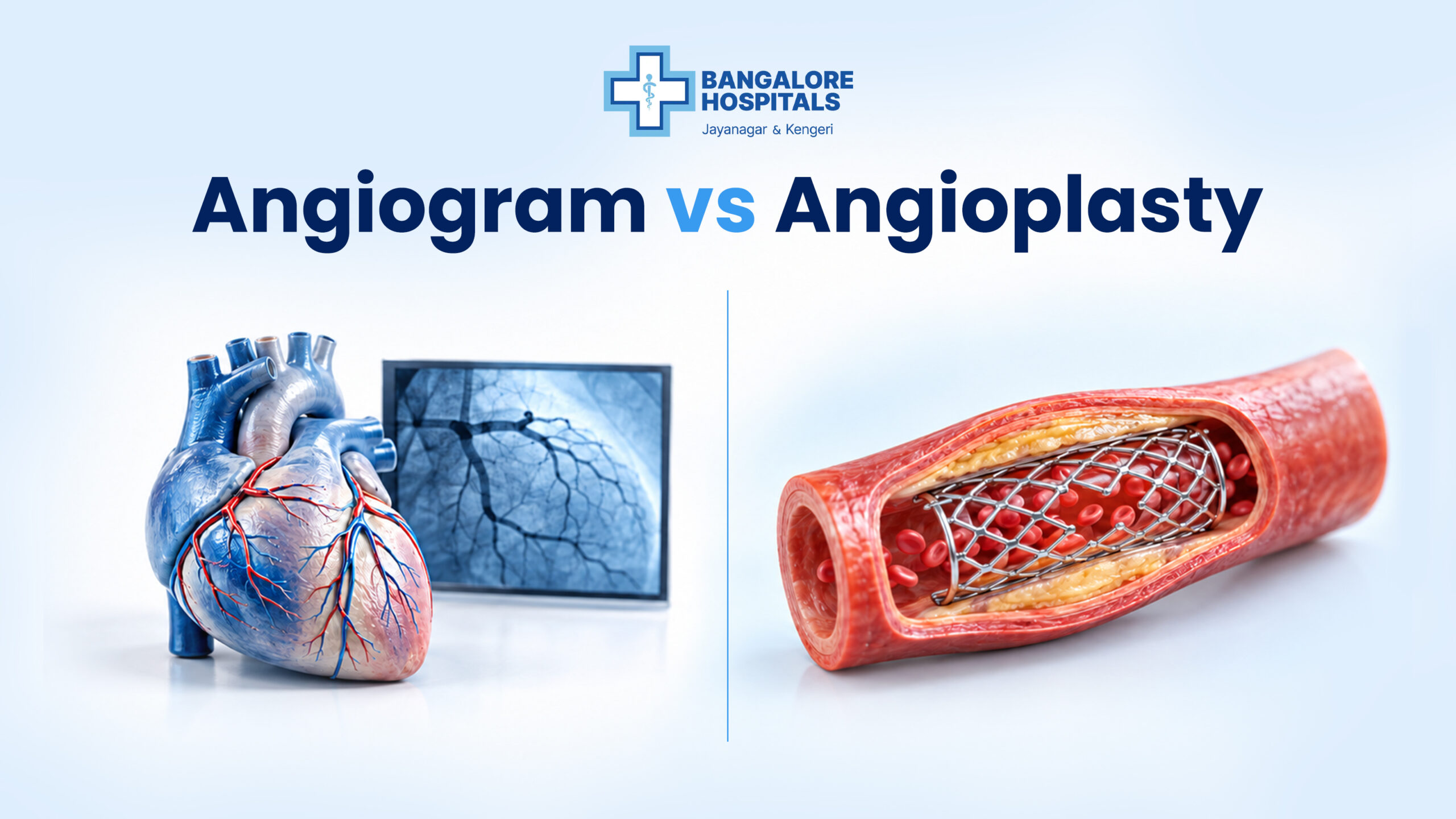
CT Angiogram vs. Catheter Angiogram — Why This One’s Painless
| CT Angiogram | Catheter Angiogram |
| Unlike traditional angiography, CT angiography is a minimally invasive procedure that does not involve inserting a catheter. CT angiography is a type of angiography that uses CT and a special contrast dye to examine blood vessels. | Angiography evaluates the blood vessels using X-ray imaging. To get a clear picture of the blood vessels, doctors inject contrast dye. It highlights the blood vessels on X-ray and helps doctors identify problems. |
| CT angiography is used to find atherosclerosis, blood vessel damage from injuries, or blood clots in the arms, legs, lungs, heart, or kidneys. | Angiography is performed to assess artery blockage when there is a lack of blood supply to the heart muscles or obstructed blood flow to the lungs. |
| In this process, you lie down on a CT scanner table. Healthcare professionals then place an IV line in your arm and inject contrast material through it. After that, the scanner takes images and creates 3D images of blood vessels. | In the traditional procedure, a mild sedative is given to the patient along with local anesthesia to make a small cut in an artery, usually in the groin or wrist. A catheter is then carefully inserted into the artery through these incisions. Then contrast dye is injected through the catheter, and an X-ray is taken to locate the blockage. |
| A CT angiogram is less invasive and does not require catheter insertion. It is more efficient for identifying congenital heart disease. | A catheter angiogram requires catheter insertion, so it is a minimally invasive procedure. |
| It is a painless, fast, accurate process that enables detailed images of the head, neck, body, legs, and arms. Sometimes during surgery, it can be used to check the condition of the blood vessels. | Doctors can do an angioplasty right away with a regular angiogram procedure. After a CT angiography, a regular angiogram might be needed to check whether one or more blood vessels are blocked. |
| The risks associated with a CT angiogram are radiation exposure. It can sometimes cause cancer, but this is very unlikely because the amount of radiation in CT scans is very low. An allergic reaction to contrast material can cause trouble breathing. Bangalore hospitals use 640-slice CT scans, which ensure minimal exposure and patient safety. | Some common risks associated with angiogram are bleeding, insertion site infections, arrhythmia, injury to the catheterized artery, allergic reactions, heart attack, and stroke |
How to Prepare for CT Angiogram?
CT angiogram is generally safe but requires some preparation before you start. First, you must fast for 8 hours before the test. Stop caffeine 12 hours before the test, as it can affect your heart rate and disrupt the procedure. Your cardiologist will tell you which medicines to stop before testing. You will be dressed in hospital clothes and will not wear jewelry or other accessories.
Most of the time, a CT coronary angiogram is performed in a hospital’s radiology department or a private imaging center. Before the procedure, the patient may receive beta blockers to slow the heart rate and improve image quality. Sometimes, nitroglycerin is administered to widen the coronary arteries, which ultimately helps the diagnosis.
During this process, a healthcare provider places a thin IV line in the arm and sends contrast material through it. The dye helps capture clear images of the blood vessels under the scanner. Electrodes are also placed on the chest to monitor heart rate. After that, the patient is placed in the CT scanner to obtain images; they must follow the radiologist’s instructions. The scanning part takes only a few minutes, but the whole process takes more than half an hour.
Is It Safe to Use Contrast Dye & Radiation?
CT angiography is safe and has fewer risks. However, contrast materials used in the procedure can sometimes cause allergic reactions, which can be treated with medication. If you know you’re allergic, tell the medical team before the procedure.
Radiation used in the test makes patients concerned about the radiation risk. However, the procedure carries very little radiation risk. Professionals will ensure the process has less radiation impact.
What Do Patients Feel After the Scan?
You can often resume your regular activities following your CT coronary angiography. As long as there are no issues from the CT scan, you should be able to drive yourself to work or home. To help your body clear the dye, drink lots of water.
Cost of a CT Angiogram in Bangalore
The cost of a CT angiogram in Bangalore is approximately ₹8,000–₹25,000, depending on the hospital’s technology, pre-scan investigation costs, and the hospital’s facilities and packages. A CT coronary angiogram provides detailed images of the coronary arteries and helps doctors determine whether a patient has blockages. Whether CT coronary angiography is needed depends on the patient’s symptoms, medical history, and the results of any other tests done. Your cardiologist decides whether a CT coronary angiogram or another heart test is best for your condition.
CT Angiography at Bangalore Hospitals
Bangalore Hospitals have advanced technology, including 640-slice CT scan machines and advanced cath labs to provide advanced care for heart-related problems. We also have a top cardiology team to support cardiac emergencies. We aim to make healthcare affordable so low-income people in our society can get care. The hospital provides care tailored to each patient’s needs. Our cardiologist and cardiac surgeon have extensive experience planning the best care. As Bangalore’s leading heart hospital, we offer a wide range of surgeries to keep your heart healthy.
FAQs
- Is a CT angiogram painful?
No. It is not painful; it is a non-invasive process, but an IV line and contrast material can cause physical discomfort.
- Do I need to fast before a CT angiogram?
Yes, you must fast for 8 hours before the procedure; avoid smoking and caffeine before the procedure, as they can affect your heart rate.
- Is a CT angiogram safer than a regular (catheter) angiogram?
Yes, because it is a non-invasive procedure, the risk of blood loss is lower, and the patient can recover quickly. In addition, the risk of surgical site infection is lower.
- Can diabetics or people with kidney issues get a CT angiogram?
Yes, diabetics and kidney patients can go for this procedure, but they need more precautions, as the contrast dye can contain iodine.
- Can I drive myself home after the test?
You can drive after the procedure, but it depends on the patient’s health conditions and recovery. It is best to avoid driving the same day.
- How soon will I get my results?
Many hospitals provide the final report within a few days, while others may take 7 to 10 days.
- Does insurance cover a CT angiogram?
Yes, most health insurance companies will pay for a CT angiography if a doctor mentions it as medically necessary.
- How much does a CT angiogram cost in Bangalore?
The average cost of a CT angiogram in Bangalore is around ₹8,000 to ₹25,000, depending on the facilities and technologies.
- What does the contrast dye feel like?
When contrast dye is injected, the body suddenly feels warm, with a flush spreading throughout the body, and a metallic or salty taste in the mouth.
- Will I feel anything when the IV is inserted?
The process can cause mild pain and discomfort that can be taken care of by the healthcare professionals.
- Should I stop any medications before the test?
No need to stop medications before asking your cardiologist. Sometimes, before the test, your cardiologist asks you to take a beta-blocker to control your heart rate.
- Will I be given a beta-blocker, and why?
Beta blockers help reduce blood pressure and slow your heart rate by blocking the effects of the stress hormone. Your cardiologist gives it before the test to slow your heart rate and get the best images.
- Do I need anesthesia or sedation?
No anesthesia or sedation is required for a CT angiogram, as it is a non-invasive procedure with no surgical intervention.
- Why do I need to hold my breath during the scan?
Holding your breath helps produce better images and a more accurate diagnosis. Follow the radiologist’s instructions to make the procedure successful
- What are the side effects of the contrast dye?
Contrast dye can cause warmth or flashing feelings with a metallic taste. In some cases, it can cause an allergic reaction, itching, and skin rashes. In extreme cases, it can affect kidney function. The patient should drink plenty of water after the procedure to help flush the dye from the body.
- Can I have a CT angiogram if I’m allergic to contrast dye?
No, doctors will suggest other investigations or take appropriate precautions to perform the test.
- Is a CT angiogram safe if I have a pacemaker?
In general, a CT coronary angiogram is safe for people who have a pacemaker. CT scans use X-rays, and most pacemakers should not have any problems with them. The American Heart Association says there is a very small chance that a CT scan will mess up a pacemaker.
- Why should I drink extra water after the test?
Drink extra water after the test to flush the contrast dye out of your body through urination.
- Do I need a doctor’s referral for a CT angiogram?
In most cases, a CT angiogram is performed on a doctor’s recommendation. A cardiologist can determine whether this test is appropriate for your condition. They can also review your medical history before the test.